
For people who upgrade everything else first
What is the oldest thing you sleep on every night?
Think about everything you have replaced in the last fifteen years. The telly went twice. The phone in your pocket went five times. The car, the couch and the fridge all got swapped somewhere along the way too. Now think about the mattress, because there is a decent chance it is the one thing in the house you have never replaced, and it is the thing you spend eight hours a day on.

You know this routine
Walk through the house with me for a second
You could probably tell me the year you bought the telly, and roughly when the fridge started making that noise that meant it was on its way out. Now try the same question about the mattress. Most people go quiet here, because the real answer is somewhere between ages ago and I actually have no idea, which is a strange thing to not know about the one item in the house you use for a third of your life.
A mattress has a working life of about seven to ten years, the same as a telly or a set of tyres. The difference is that a telly fails all at once, so you notice and replace it, while a mattress fails in millimetres, too slowly to feel from one week to the next. So you adapt instead. You find the good side, you learn which way to roll out of bed, and your body absorbs a bit more of the job the mattress used to do. That is you compensating for a mattress that already stopped doing its job.
Why it wears out and why you missed it
What actually happens to a mattress over ten years
A mattress does not have a use by date printed on it, so it is easy to assume it just lasts forever. It does not. Here is what is actually going on underneath you, one year at a time.
01
The foam softens exactly where you lie
Every mattress has foam layers on top of the support, and foam is not designed to hold its shape forever under the same weight in the same spots every single night. Over the years it softens where your shoulders and hips press down, because that is where the pressure always lands. The springs underneath lose a bit of their push back too, the same way an old trampoline gets less bouncy. Put those two together and the middle of the bed starts to dip by a few millimetres a year, which does not sound like much until ten years of it adds up to a real dip you can see with the sheet pulled back.
The surface sinks lowest under the hips, a little every year.
02
Why you never noticed it happening
Nobody wakes up one morning to a mattress that has suddenly failed. It happens so slowly that your body just adjusts along with it, finding the spot that still works and learning to sleep around the dip instead of noticing the dip. Here is the giveaway most people have felt without putting it together. You go away for a weekend, sleep in a hotel bed you have never met before, and wake up feeling brilliant. You put it down to the holiday. But often it is not the holiday at all. It is just a mattress that has not had ten years to wear a hole in exactly the shape of you.
The change is too small week to week to ever feel, until you sleep somewhere else.
03
The signs it has already happened to yours
Since the wear is gradual, the best way to check is a short list rather than a feeling. Look for a visible sag or body shaped dents when you strip the bed and look across it side on. Notice if you wake up stiff and it eases once you start moving around, which is a strong sign the surface rather than your body is the problem. Pay attention if you consistently sleep better anywhere else, a hotel, a caravan, a mattress at your parents' place. And listen for creaking, or feel for every movement travelling across to your side of the bed, both signs the springs underneath have had enough.
If two or more of these sound familiar, the mattress has probably already told you.
Try it yourself
Drag the slider through ten years of a mattress
This is the same mattress at different points in its working life, from brand new through to about ten years old. Nobody sits down and decides their bed has failed. It happens exactly like this, one small year at a time, until the spine that used to lie flat is bowing every single night.
An illustration of how support loss changes over a mattress's working life rather than a lab measurement. Every mattress and every body is different, which is why the fix starts with what your body needs.
The buying checklist
What to look for so the next one actually lasts
If the last mattress wore out in a decade without you clocking it, the replacement is worth choosing on more than looks. Here is what to check before you buy, and it applies whichever brand you end up going with.
A proper spring core
An all foam slab is the layer most likely to soften and dip early, because foam alone has nothing underneath it holding its shape. A real spring core keeps its structure for years, which is exactly the part that let you down last time.
A written 15 year warranty
A warranty is the maker telling you, in writing, how long they expect the build to hold up. A long warranty on the mattress you are looking at now is the best clue you have that you will not be back here doing this again in five years.
A trial long enough to actually judge it
Two minutes lying down in a showroom told you nothing last time either, which is part of how you ended up with a mattress that failed for years without you noticing. A home trial measured in months rather than days is the only way to judge a bed the way you actually use one.
A word on firmness. None of this checklist tells you whether you need something firmer or softer than the bed you are replacing, and that part is personal rather than universal. It depends on your build and how you sleep, and that is exactly what the two minute quiz at the bottom of this page works out for you.

That checklist is not a wish list. It is a build spec, and one Australian family has been building to it for a long time.
Sixty years in the trade
Built so the parts that wore out last time do not this time
Mattress Crafters is an Australian family business with sixty years in the mattress trade, which is long enough to know exactly which parts of a mattress give up first. The Boutique is built to answer that, layer by layer, and the clearest way to show you is to take it apart. Scroll through and notice each layer is aimed at the part of the old mattress that let you down.
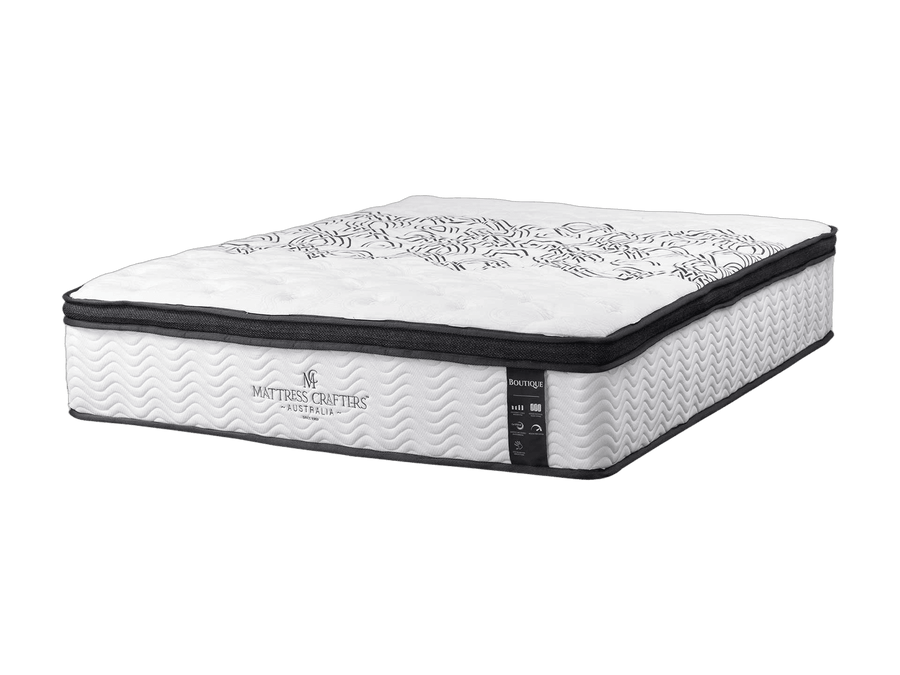
LAYER 01
Crafter Stretch Knit cover
The surface you actually touch is a breathable Crafter Stretch Knit that lets heat escape instead of trapping it, so the bed stays fresh and cool against your skin for years to come.
Stays fresh instead of ageing into something you tolerate
LAYER 02
CrafterCore Plus convoluted foam
Just beneath the cover sits the pressure relief layer. It softens to the exact shape of your shoulders and hips and spreads their weight across the surface, which is a different job to the flat all foam slab that dips permanently once it has been slept on for a few years.
This is the part that wore out last time
LAYER 03
Seven zone CrafterCoil pocket springs
The core is a seven zone pocket spring system that gives each part of your body its own support, keeping the middle of the bed level instead of letting it dip into a hammock over the years. Every spring is wrapped and moves on its own, so the structure holds its shape rather than sagging as one flat unit the way a worn out bed does.
A real spring core is why this one lasts
LAYER 04
Quality foams
Every foam inside is chosen for comfort and durability. The whole build is compressed into a single box that fits through any doorway, arrives free, and is ready to sleep on within a day, backed by a written 15 year warranty on how long it should hold up.
A 15 year warranty on the part that matters
Verified reviews
People who finally replaced it
These are verified reviews from the Mattress Crafters store, from people who had put off replacing their mattress and then actually did it.
"Honestly did not expect a boxed mattress to be so comfy. It is nice and firm, I feel properly supported, and it does not feel like you are bouncing on springs. It almost feels better than a $2000 plus Sealy mattress."
"Very happy with my new mattress. My previous one gave me discomfort and stiffness in the lower back on waking. Now I am more mobile and free of discomfort in the morning."
"Bought four of these for our new rental property. They arrived on time and for the price they are an excellent mattress. They take a day to decompress and a few sleeps to bed in, then they are very good for what you pay."
"It was such a surprise to see a quality mattress pop out of the box. Not too hard, not too soft, my Goldilocks mattress. My daughter is now going to purchase one."
"This company is super efficient and transparent to deal with. The mattress was delivered next day, and when I made a mistake with my order they got straight back to me and fixed it with no fuss. Great comfortable mattress for a great price."
Drag or scroll sideways for more
The obvious objection
Replacing it should not cost what it did last time
A mattress built to the checklist above usually carries a four figure price tag, so $379 reads like a catch. The catch is real, it just is not in the mattress. Most of what you pay in a traditional store never touches the bed you take home, which is a fair chunk of why the first one cost what it did a decade ago.
The only test that counts
Give the new one four months
You put up with the old mattress for years without really questioning it, so it only seems fair that the new one gets a proper trial rather than a rushed verdict after two nights. Two minutes lying down in a showroom tells you nothing about hour seven of night forty, and neither did the two minutes you spent choosing the mattress you are replacing.
That is exactly what the 120 night trial is for. The Boutique arrives at your door for free, and you get four months of real mornings in your own bedroom to judge it on. If those mornings have not changed, you send it back and get your money back.*
The risk sits with us, not with you. And once you have judged it properly and kept it, it is backed by a 15 year warranty, so the wearing out that snuck up on you last time has an actual number on it this time.
*The 120 night trial is a money back comfort guarantee. A return can be started after the first 30 nights, and the full mattress price is refunded. The only cost is a flat $250 pickup fee if you ask us to collect it, and your free delivery is never deducted. Soiled or damaged mattresses cannot be returned.

Seven quick questions about a minute long
Find a fit that is not just a repeat of the last one
The range has firmer options and softer options than the bed you are replacing, so there is no reason to just buy the same firmness again out of habit. Answer seven quick questions about your build and how you sleep, and the quiz will point you to the model that actually fits you.
Prefer to skip the quiz? Go straight to the Boutique from $379