
For health minded Australians over 65
Who told you broken sleep was part of getting older?
Most of us over 65 were raised to believe a broken night is just what happens now, so the 3am ceiling stare gets filed away as normal. Some of that is genuinely age. But some of it is the bed underneath you, and at this stage of life that difference matters more than it ever did at 40. This page walks through which is which.

You know this routine
The ceiling audit at 3am
You know the ceiling at 3am better than you would like to. Eyes open, no obvious reason, and that quiet little audit starts running. Hip. Shoulder. Whatever spot is talking tonight. You get up sore, you say you slept terribly the same way you would mention the weather, and everyone your age says some version of it, so it never occurs to you to question it.
But some of those wakings are age, and some are pressure, heat and a partner shifting the mattress under you, and those are not the same thing. One you cannot do much about. The other is sitting under you every single night, and it is the one input into your sleep you can change this week. A body that genuinely needs to move is doing something different to a body nudged awake by a hot patch or a hip digging into an old mattress, and only one of those is fixable from the bedroom.
The overnight mechanics
Why sleep changes shape after 65
Sleep genuinely gets lighter as you get older, and that is real and not something to fight. But lighter sleep also means the small disturbances your body used to sleep straight through now have the power to wake you, and three of those disturbances are sitting in your mattress rather than in your age.
01
Lighter sleep costs more per disturbance
At 30, a pressure point or a warm patch under the covers barely registers, your body sleeps through it without missing a beat. At this stage of life your sleep naturally sits closer to the surface, so the exact same disturbance now has enough to actually wake you. Nothing is wrong with you for that, it just means every avoidable bump in the night matters more than it used to, and cutting a few of those bumps out matters more too.
Side sleeping concentrates body weight at the shoulder and the hip.
02
Deep sleep is worth protecting now more than ever
Deep sleep is the stretch of the night where your body does its quiet repair work and your mind files away the day, and large studies keep linking consistently short or broken sleep in older adults to poorer heart health and slower recovery from the ordinary wear of daily life. You do not need a study to feel the difference, a night of real unbroken sleep leaves you a different person the next day to a night of constant surfacing. Protecting that stretch of sleep is worth taking seriously, and the surface you lie on is one of the few parts of it you can actually control.
A level spine rests through the night instead of working to hold its shape.
03
Three avoidable wakers hiding in the mattress
Strip it back and there are three things in a mattress that cause avoidable wakings. Pressure building up at the hips and shoulders. Heat trapped against the skin instead of escaping. And a partner's movement travelling across the bed and landing on your side of it. None of those three are about age, they are about the build of the surface underneath you, and every one of them can be designed out of a mattress.
On connected surfaces one sleeper's movement becomes both sleepers' problem.
Try it yourself
The slow sag nobody notices
A mattress does not fail like a light bulb. It fades a little every year, softening exactly where you lie, and because you adapt just as gradually you never catch the moment it stopped supporting you. Drag the slider and watch what those years do to a spine, and to the wakings that come with it.
An illustration of how support loss changes sleeping posture and the wakings that come with it, rather than a lab measurement. Every mattress and every body is different, which is why the fix starts with what your body needs.
The buying checklist
What your body needs from a mattress after 65
Once you accept that lighter sleep makes small disturbances louder, the requirements almost write themselves. You can take this list to any brand, on any budget, and judge a mattress against it.
Pressure relief that works at lighter sleep
The layer under your shoulder and hip needs to soften to their shape and spread the load, because at this stage of life a pressure point that used to be background noise is now enough to bring you up out of a light sleep. Take the pressure away and you take away one of the easiest reasons to wake.
Cooling where you actually sink
Trapped heat is one of the three avoidable wakers, and it builds up exactly where your body presses down hardest. A surface that lets that heat escape instead of holding it against your skin removes another reason to surface halfway through the night.
Springs that keep their movement on their side
If you share a bed, every one of your partner's turns should stay on their side of the mattress instead of travelling across to you. Independently wrapped springs stop that motion transfer cold, which means their restlessness stops adding hours to your own.
A word on firmness. There is no single right feel for everyone over 65. Some bodies want a firmer surface that holds them level, others want more give under the hip and shoulder. Where exactly you land depends on your build and the position you sleep in, and that is precisely what the two minute quiz at the bottom of this page works out for you, including whether the flagship suits you or a firmer feel would suit you better.

The checklist above is not hypothetical. It is a build spec, and one Australian family has been building to it for a long time.
Sixty years in the trade
A layer for every waker on this page
Mattress Crafters is an Australian family business with sixty years in the mattress trade, which is long enough to have heard every version of the broken night you read about above. The Craft Cell Hybrid is the flagship built to answer it, and the clearest way to show you is to take it apart. Scroll through the five layers and notice that each one exists to solve something you just read.
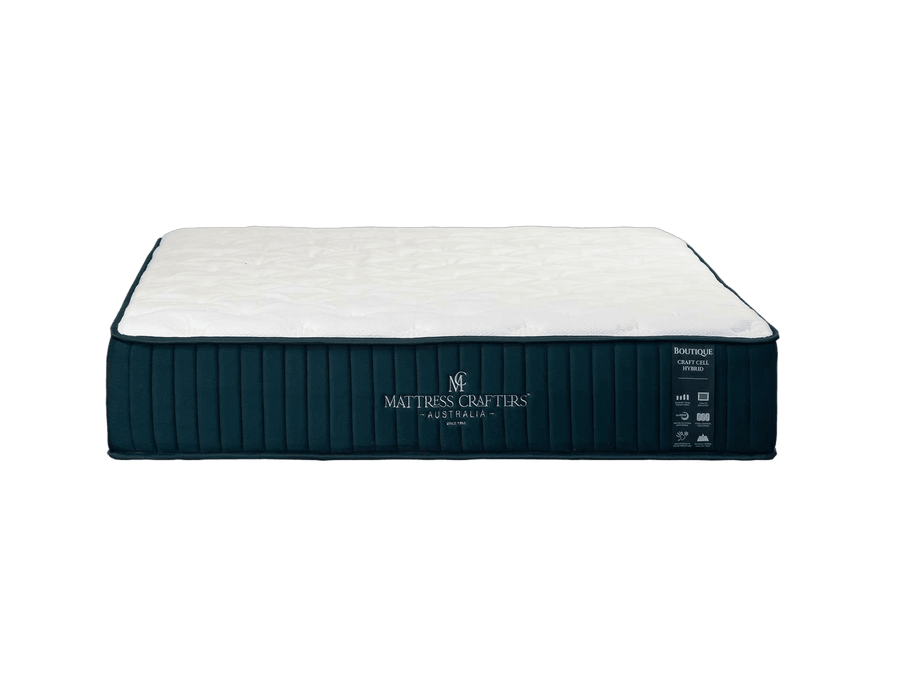
LAYER 01
Crafter Stretch Knit cover
The surface you actually touch is a Crafter Stretch Knit built so air moves straight through it instead of getting trapped against your skin. It stays cool from the first minute you lie down, which starts you off ahead on one of the three avoidable wakers before you have even fallen asleep.
Answers trapped heat from the first minute
LAYER 02
CrafterLastic latex
Underneath the cover is a CrafterLastic latex layer with a buoyant, plush feel that springs gently back as you move rather than holding your shape like a mould. It gives you the soft top surface without ever feeling stuck in one position.
A plush top that still lets you move freely
LAYER 03
CrafterCool-Ice gel foam
Right where your body sinks in deepest, a gel infused foam layer draws heat away from your skin so the plush feel above it never turns into an overnight sweat. This is the layer built specifically to stop heat building where the pressure is highest.
Answers heat building exactly where you sink
LAYER 04
CrafterCore Plus convoluted foam
Below the cooling layer sits the pressure relief. It moulds to the shape of your shoulders, hips and lower back and spreads their weight across the surface, so the pressure that usually builds through a long night has nowhere to concentrate and dig in.
Answers pressure at the hips and shoulders
LAYER 05
Seven zone CrafterCoil pocket springs
The core is a five zone pocket spring system with a firm foam encased edge, running zoned support along the bed while keeping motion transfer to a minimum. Every spring is wrapped and moves on its own, so a partner's turn stays on their side of the bed instead of travelling across to wake you.
Answers a partner's movement crossing the bed
Verified reviews
What the flagship's own owners say
The Craft Cell Hybrid only has three reviews so far, and these are all three of them, verbatim from verified owners of the flagship itself.
"I was concerned it would not be comfortable for me, as mattresses are such an individual choice. The hybrid is comfortable and supportive, soft enough to cushion but with great support."
"It is super comfortable, light in weight and ticks all the boxes you need in a mattress."
"I really was not sure what to expect with a hybrid, having always slept on a latex mattress, but Bianca was amazing, providing information and pictures to help me choose."
Drag or scroll sideways for more
The obvious objection
Why the price looks too low
A five layer hybrid built the way the checklist above demands usually carries a four figure price tag, so a Queen from $899 reads like a catch. The catch is real, it just is not in the mattress. Most of what you pay in a traditional store never touches the bed you take home.
The only test that counts
Judge it on the 3am wakings
You cannot judge any of this lying down for two minutes in a showroom with your shoes on. The only test that means anything is the one you already run every night, whether you wake at 3am and how sore you are when you get up, repeated in your own bedroom for weeks rather than minutes.
That is exactly what the 120 night trial is for. The Craft Cell Hybrid arrives at your door for free, and you get four months of real mornings to judge it against your own ceiling audit. If the wakings have not eased, you send it back and get your money back.*
The risk sits with us, not with you. And if it does its job, it keeps doing it, because the build is backed by a 15 year warranty rather than the shorter life you get from cheap all foam beds.
*The 120 night trial is a money back comfort guarantee. A return can be started after the first 30 nights, and the full mattress price is refunded. The only cost is a flat $250 pickup fee if you ask us to collect it, and your free delivery is never deducted. Soiled or damaged mattresses cannot be returned.

Seven quick questions in about a minute
Find the fit your body needs
Everything on this page comes down to matching the surface to your build and the way you sleep. Answer a few quick questions about both and the quiz will confirm whether the Craft Cell Hybrid is the right fit for you or whether a firmer feel in the range would suit you better.
Prefer to skip the quiz? Go straight to the Craft Cell Hybrid from $749